

Travel Information | Visit Chiba | Latest update:2026/11/05
Contents
Train Service Update for Chiba | October 26, 2026Frequently asked questions regarding Tokyo–Chiba AccessIntroducing Chiba's Iconic RailwaysSome of Chiba’s train services are currently suspended or operating on reduced schedules. If you’re traveling around Chiba, please check the latest service information before heading out, as the situation is changing as recovery work continues.
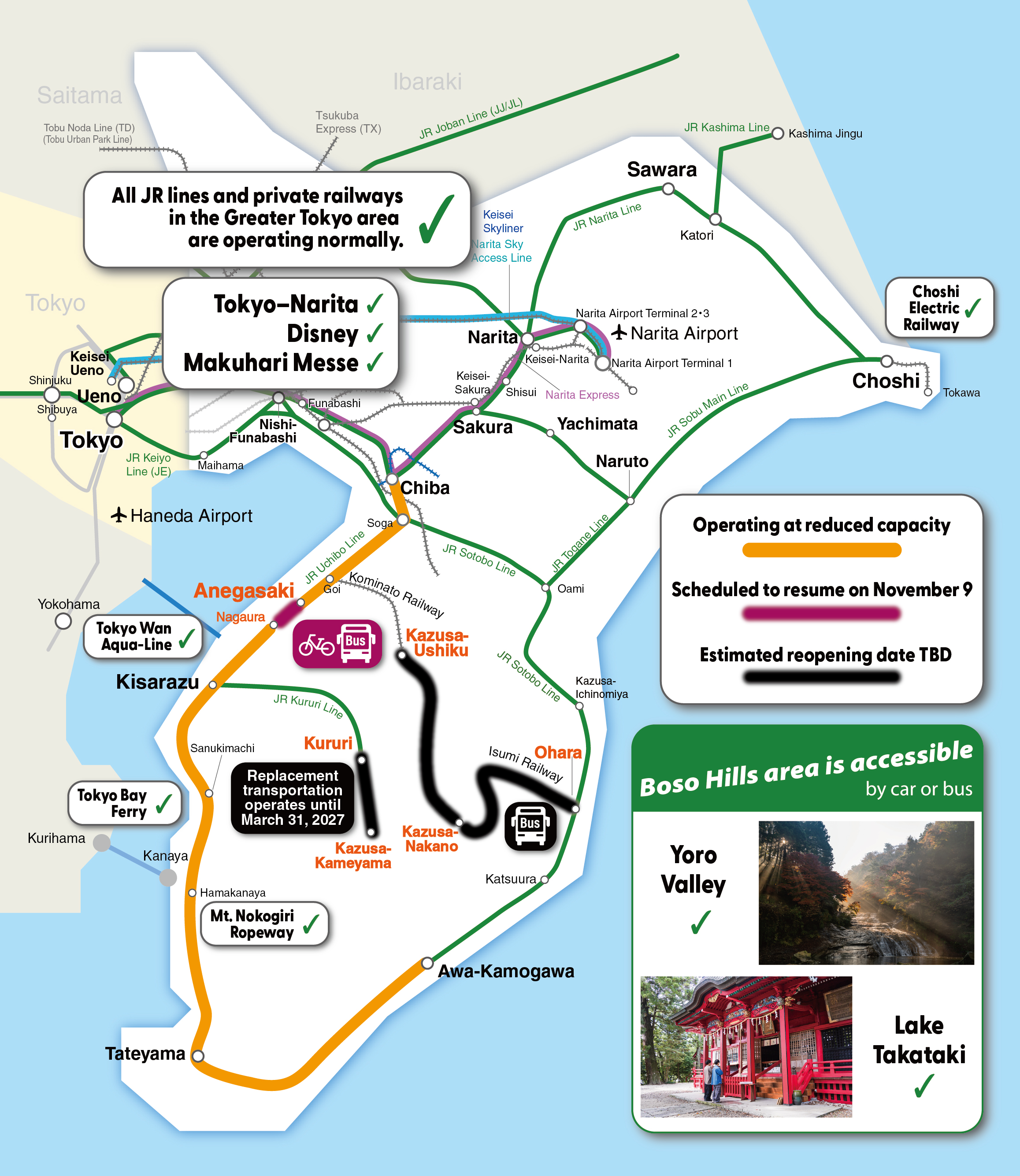
• JR Uchibō Line: The Anegasaki–Nagaura section is scheduled to resume service on November 9. The Kisarazu–Nagaura section will be suspended on November 8 to prepare for the resumption of service the following day. Replacement bus services will operate only between Anegasaki and Nagaura on November 8.
Currently, train services between Anegasaki and Nagaura are suspended. Replacement bus services and temporary bicycle rental services* are available along this section. Train services between Nagaura and Awa-Kamogawa, and between Chiba and Anegasaki, are operating on a reduced schedule.
* Registration via the HELLO CYCLING app is required. Fees are normally charged based on usage time. However, bicycle rentals between the two stations are free of charge when the bicycle is returned within the designated time limit. Learn more about the service on the official website of the Chiba Prefectural Government.
• JR Kururi Line: Kisarazu–Kururi is operating normally. The Kururi–Kazusa-Kameyama section has been confirmed for permanent closure. Replacement transport services will be available through March 31, the section’s originally scheduled discontinuation date.
• Kominato Railway: Kazusa-Ushiku–Kazusa-Nakano is suspended. Goi–Kazusa-Ushiku is operating normally. Due to limited capacity, replacement transportation services operate only a few times a day and prioritize local commuters.
• Isumi Railway: Remains fully suspended following a previous derailment. Replacement bus service is available.
Q: Can I access major facilities along JR Keiyo Line such as Tokyo Disney Resort and Makuhari Messe?
A: The JR Keiyo Line is currently operating normally, and there is no significant impact on access to major attractions and facilities along the line. However, typhoons are common in Japan during the autumn season, and train services may be affected by weather conditions in the coming days. We recommend checking the latest service information on the JR East website before setting out.
https://traininfo.jreast.co.jp/train_info/e/kanto.aspx
Q: Are major autumn festivals such as the Sakura Autumn Festival and Sawara Grand Festival held?
A: Yes, both festivals are scheduled to take place from October 9 to 11. This year, Sakura Autumn Festival is expected to take place with an altered schedule. To see similar scenes to those in this video (https://www.instagram.com/p/DeF6AxfTSZv/), Visit Chiba team recommends coming in the evening on any of the three nights when the festivities center along the “Shin-machi Dori” road. The “Shin-machi Dori” road is located between JR Sakura and Keisei-Sakura stations. Please keep in mind that while the JR Narita Line is currently operating normally, JR’s broader service information notes some reduced/cancelled services on other lines that serve JR Sakura Station.
Q: Is the Boso Hills area accessible?
A: Yes, the Boso Hills area is accessible. Although the railways were affected by the natural disaster, sightseeing spots such as Yoro Valley and Lake Takataki have largely recovered from the damage and remain great options for a short getaway near Tokyo this autumn and winter.
Highway buses from central Tokyo to Ichihara and Kamogawa are available, with minimal changes to their schedules. For those planning to drive around the area, it is recommended to check the latest road closure information on the Japan Road Traffic Information Center (JARTIC) website.
Q: Are the fall foliage viewing spots in Chiba accessible in 2026?
A: Yes, most fall foliage viewing spots in Chiba remain accessible for the 2026 season. Thanks to Chiba’s mild climate, the autumn leaves change color later than in many other parts of Japan, with the best viewing period typically lasting from late November through early December.
Hondo-ji Temple in Matsudo and Naritasan Park make great half-day trips from Tokyo and Narita Airport, respectively. If you’d like to explore more of Chiba and perhaps combine your visit with a relaxing stay at an onsen ryokan, Yoro Valley is well worth a visit.
Learn more about these three recommended spots here:
https://www.visitchiba.jp/things/fall-foliage-guide/
Q: Are the fall foliage viewing spots along the Kominato Railway accessible in 2026?
A: Yes, most fall foliage viewing spots, including Yoro Valley, are accessible by car. Please note, however, that train services between Kazusa-Ushiku and Kazusa-Nakano on the Kominato Railway are currently suspended.
Unfortunately, this means that the picturesque countryside scenes of Kominato Railway trains winding through colorful autumn leaves and rice fields, beloved by local photographers, cannot be captured this year.
If you’re looking for how to get from Narita to Tokyo, please click:
Narita to Tokyo: 3 ways to go | Visit Chiba
Chiba is situated on the Boso Peninsula and trains can take you along both the Tokyo Bay and Pacific coastlines here, in addition to routes that cross the countryside in the interior. One convenient way to travel from Tokyo down Chiba’s Pacific coast is the Wakashio Limited-Express train. To learn more, please click:
JP Rail | Limited-Express Wakashio
 A Wakashio Limited-Express train riding down the JR Sotobo Line
While you can zip around Chiba on limited-express and rapid trains, a ride on one of the local train lines gives you an intimate look at the charming communities and beautiful scenery on offer here. Learn more about these local train lines below:
Choshi Electric Railway | Visit Chiba
Isumi Railway | Visit Chiba
Kominato Railway | Visit Chiba
Ryutetsu Nagareyama Line | Visit Chiba
*The Isumi Railway is currently shut down indefinitely for repairs following a derailment. We will post updated information as soon as it’s provided to us. Temporary bus service is available along the line.*
 Choshi Electric Railway
 Isumi Railway
 Kominato Railway
 Ryutetsu Nagareyama Line
The Chiba Urban Monorail runs on a suspended monorail system, meaning the cars hang from the track–as opposed to riding above it! Chiba’s monorail was even certified by Guinness World Records as the world’s longest of its kind, with an operating distance of 15.2 km.

There are two ways to pay for your fare on a train in or around Chiba: purchasing a ticket to your destination or using a chargeable IC card like the SUICA and PASMO cards. IC cards are the preferred method of payment for most riders, as they save you the time and hassle of buying a ticket each time you ride the train.
IC cards can also be used to ride the Tokyo Metro and many of the Tokyo and Chiba area bus lines as well. They can also be used to purchase goods from many vending machines and shops, both inside and outside train stations. You may purchase a SUICA card with a 500-yen deposit, then charge it with at least a 1,000-yen balance (500-yen deposit included).
Please keep in mind that some trains can only be boarded with a ticket, such as the four “Local Train Lines” introduced above. Usually, you can buy a ticket on a machine outside of the station gates, or from a conductor on the train.
To ride a limited-express train, you enter the station gates as usual, but you also need a separate ticket to show the conductor after you’ve boarded. You can buy a limited-express ticket online, on a machine inside or outside of the station gates, or from the conductor on the train. Limited-express trains usually have reserved and non-reserved seating.